
Poetry Books by M. Brooke Wiese
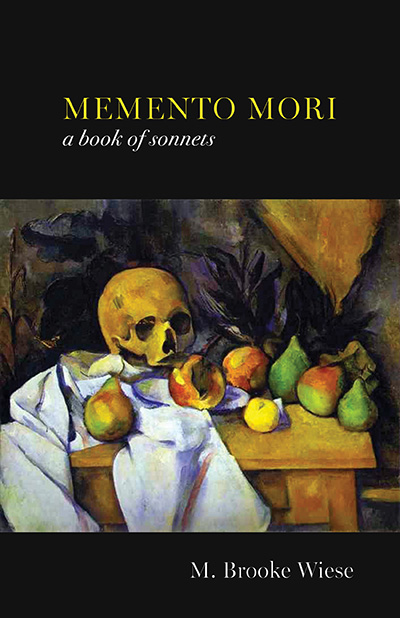
Memento Mori: a book of sonnets
 by M. Brooke Wiese
Paper
$17.99
ORDER YOUR COPY TODAY from FINISHING LINE PRESS
Many years have transpired between the publication of M. Brooke Wiese’s first chapbook and this, her second, Memento Mori, published by FLP. Wiese’s first, titled At the Edge of the World and written in her “salad days,” was full of youthful wonder and romantic yearnings. In this book, Wiese considers with the practiced eye of a lifelong observer all the things that make up a life: the flush of youth in her teenaged sons, failed relationships, renewed love, the societal tragedies of our own creation, the death of parents “papery and brittle as a late-Autumn leaf riddled with pinholes,” and her aging self – “I am losing at least one word a day…” – a poet’s worst nightmare.
In one poem the poet holds her fingers to the night sky on either side of the bright, full moon as if she is cradling it between her spread fingers, or holding her whole world in her hand. From inside the shadows of mortality, Wiese looks forward and back and then forward again, meditating on the renewal of life in a spring leaf unfurling “in palest green,” the magnificence of a red-tailed hawk gallivanting around the city, delight in a pod of dolphins spotted on a beach walk, and the lights across the bay that “glitter along the mainland shore like far-away planets and stars.” There’s always something new to see.
Allen Ginsberg is a Mensch – New!
by M. Brooke Wiese
Paper
$10.00
In Allen Ginsberg is a Mensch, published by Bottlecap Press, Wiese looks back at her youth, but this time with the eye of maturity, and a better understanding of where the events of her youth fall on the continuum of her life. In this, her third book, Wiese writes of her relationship and experiences with the old poet, the standard-bearer of the Beat Generation of poets and authors who came to prominence in the 1950s and 60s, and whose work influenced the culture of the post-World War II era. Ginsberg himself was a guru or guide of the radical changes in poetry that began in the late 19th century with Walt Whitman, continued with Pound and Eliot, and continues to be the dominant poetic form today. Ginsberg used free verse to express countercultural ideals, often with a sense of humor and play.
In this short work, Wiese creates a picture (real and imagined) of the “ageing, famous, bearded Buddhist bard” who instructs her and her fellow student poets at night at Brooklyn College, and she takes delight at the upbraiding of a particularly self-absorbed student. She creates a vivid scene of a party at Ginsberg’s apartment (and of the apartment itself), where Ginsberg’s friends – other ageing Beats of notoriety – seem to be brought in as special exhibits for the young poets. And she returns at the end, with quiet contemplation, to end-of-life scenarios – his mother, hers, the old poet himself. Her respect for and love of Ginsberg is a translucent wash across every poem.
In the same way that the imagists, the modernists, and then the Beats broke with the earlier traditions of strictly metered and end-rhymed poetry, Wiese breaks from the free verse of her teacher/tutor/mentor Allen Ginsberg, and writes her homage to him using the strict forms of rhymed and metered quatrains, Shakespearean and Petrarchan sonnets, and even a Renga chain of poems, remembering the importance of Eastern influences on Ginsberg.
